A long day on sgit.ai. A reader's question about performance produced a new page↗ that was corrected and extended over six more releases, and later in the day came a startup operating model↗, a section for founders↗ and an article on the SaaS apocalypse↗ that changed its title three times. On riskmandate.ai, a free first step↗ for people who have never written a behaviour policy.
Lead: A reader asked how fast fractal graphs are, and sgit.ai kept measuring until the page was right
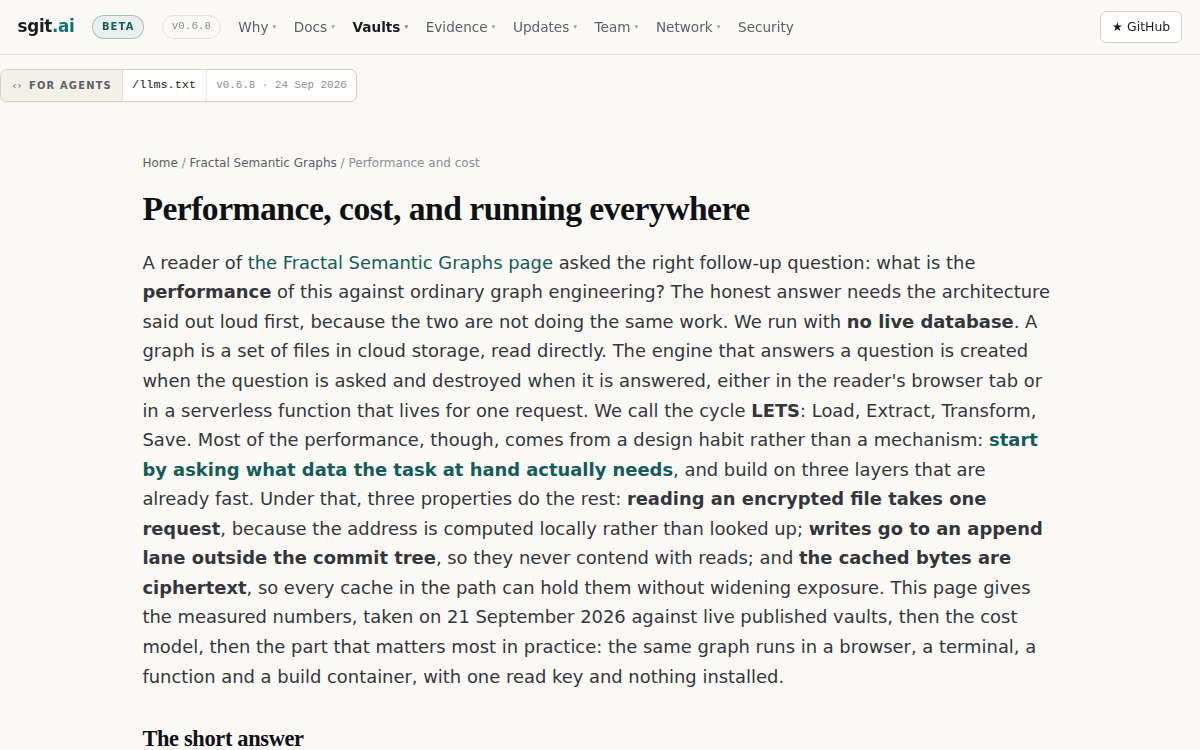
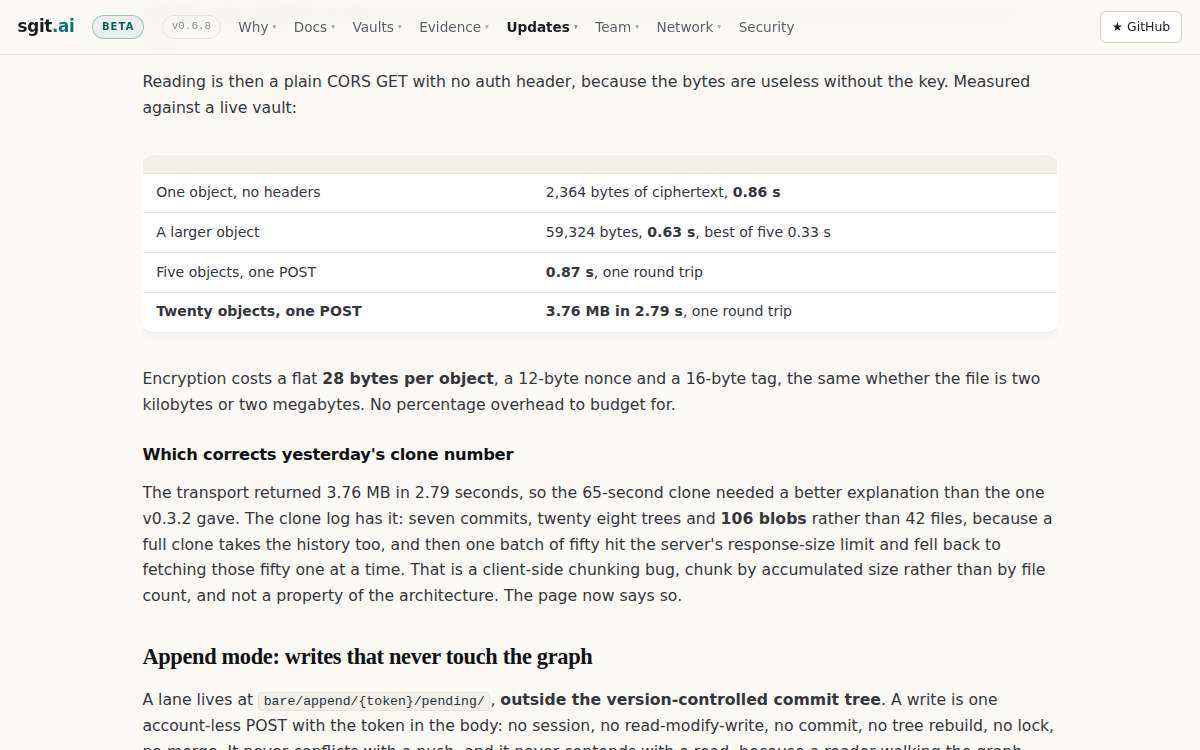
After the Fractal Semantic Graphs page went out, a reader asked how its performance compares with ordinary graph engineering, and sgit.ai answered with a new page↗ whose figures were measured on 21 September against live published vaults (the update↗). The first version gave a sparse clone of the DSIT vault at 7.3 s and 256 KB, one 59 KB file at 0.49 s, and a full clone at 65.4 s (version log, v0.3.2↗). It named the architecture: no live database, files in object storage, and a cycle called LETS, Load, Extract, Transform, Save (the page↗).
The author, as the version log calls them, then read the page, and it kept changing. v0.3.3 found the 65 second clone was mostly a client-side chunking bug and "not a property of the architecture", and reported that the documented Cache-Control header was not being served on the read path (the update↗, the page↗). v0.3.4 found the DSIT graph had grown from 617 to 1,051 nodes since its vault page was written, so every count is now counted rather than quoted (version log↗). v0.3.5 opened: "THE HEADLINE LATENCY WAS A COLD START PRESENTED AS AN ARCHITECTURE COST" (version log↗). v0.3.6 ran the same clone against plain GETs with no API in the path, 2.63 s against 65.4 s, with the caveat that the static host was localhost (the update↗, version log↗). Then v0.3.7 and v0.3.8 made the page findable, including a new Fractal Semantic Graphs band on the homepage↗ (version log↗).
The page keeps a section for what it loses: "This page would not be worth sending if it only listed wins." (the page↗). Six hops across a hundred million edges in one schema is, it says, exactly what a graph database was built for (the page↗). The same measurements were cited within hours by the startup article as the reason a file system can be the database (the article↗).
The full sequence, release by release, is in a longer piece.
Also today
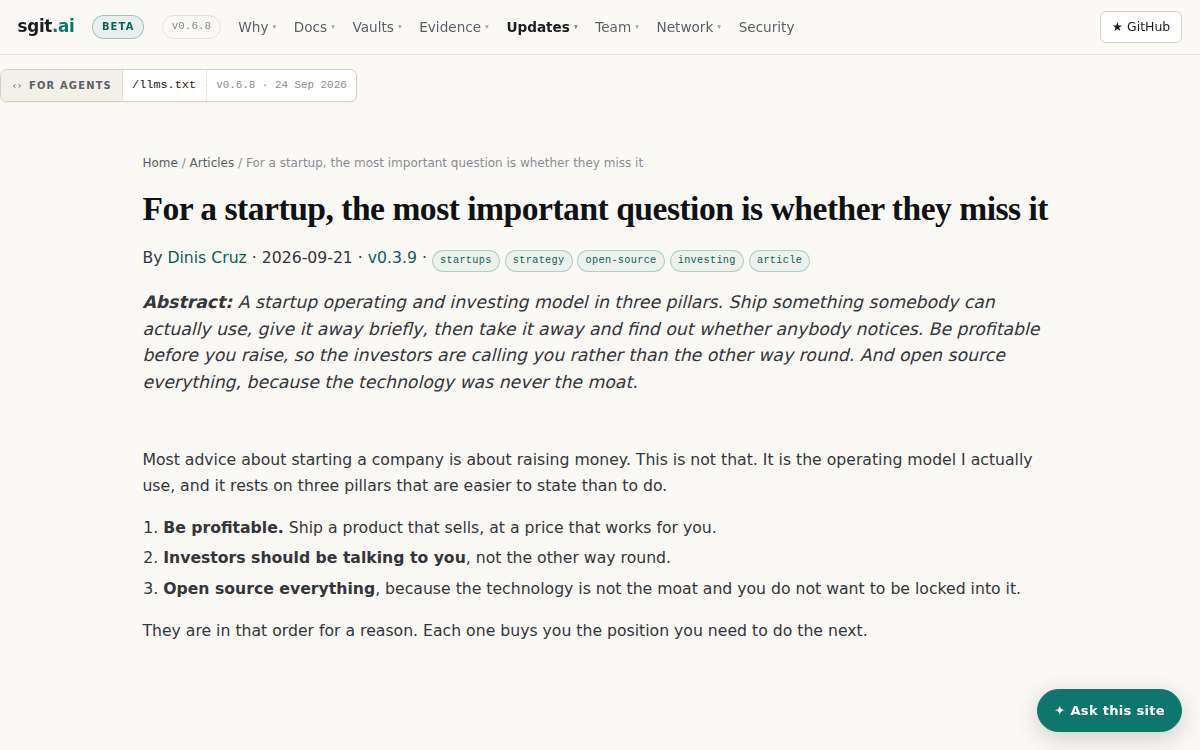
For a startup, the question is whether they miss it
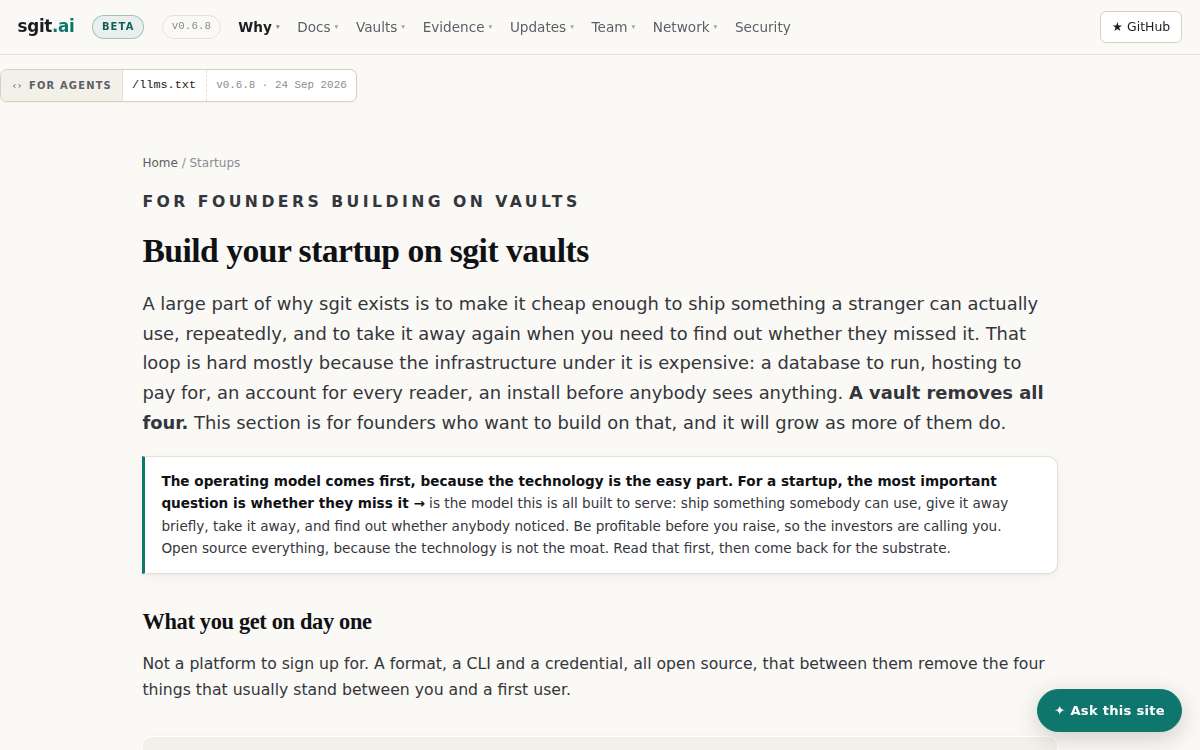
sgit.ai published the founder's startup operating and investing model in three pillars: be profitable, investors should be calling you, and open source everything (the article↗). Its test is to ship something usable, give it away briefly, take it away, and ask one question: "Do they miss it?" (the article↗). On raising money, its analogy is music: "Do not get signed before you have the album." (the article↗). The article is the centrepiece of a new startups section↗, which lists the four costs a vault removes and what a founder still has to bring, billing and payments being "Not here, not planned" (the section↗). Later the article took the title it had been given on LinkedIn (version log, v0.4.4↗).
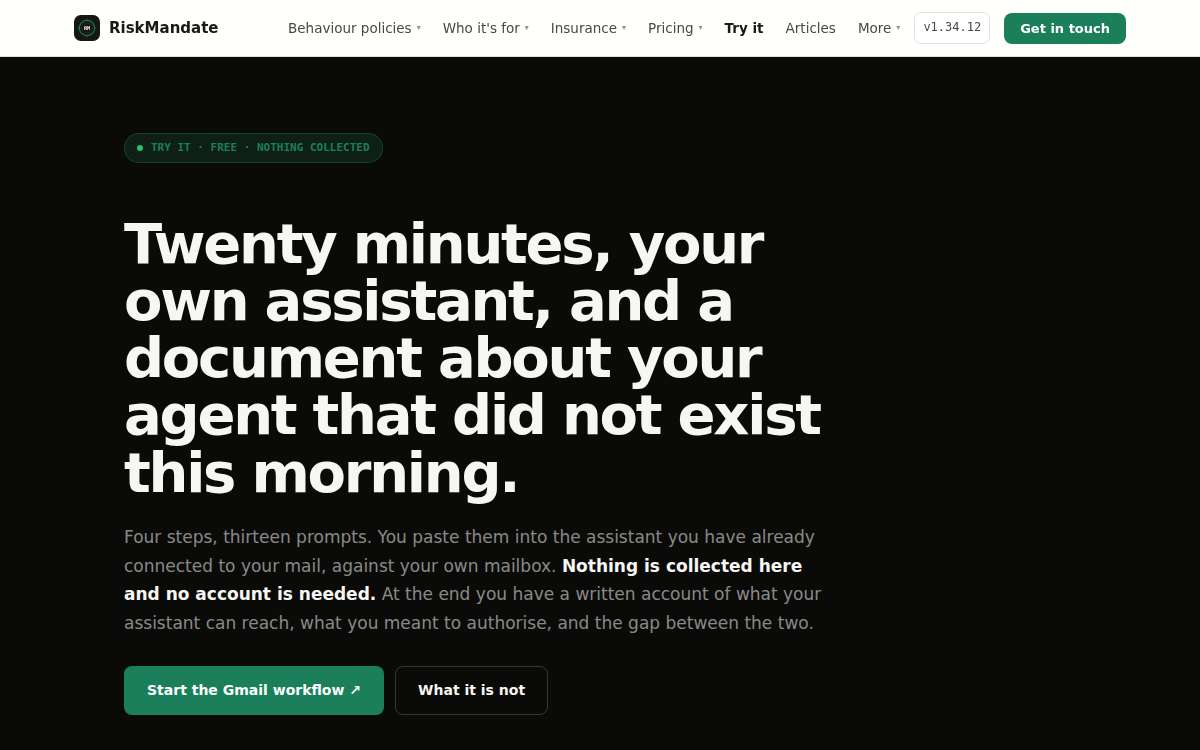
riskmandate.ai adds a free rung: Try it
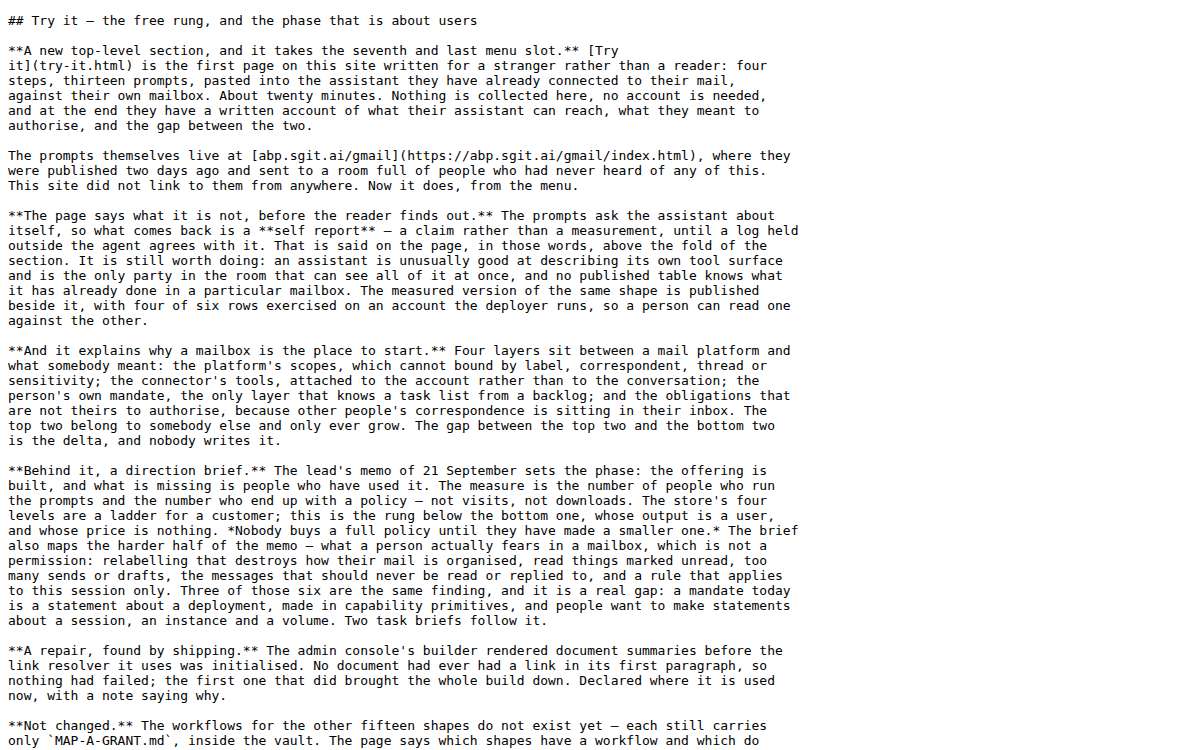
riskmandate.ai's new Try it↗ section offers four steps and thirteen prompts, pasted into the assistant already connected to a person's mail, with nothing collected and no account needed (the page↗). The page says plainly that what comes back is a self report, a claim rather than a measurement, until a log held outside the agent agrees with it (the page↗). A direction brief behind it sets the measure as people who run the prompts and people who end up with a policy, not visits: "Nobody buys a full policy until they have made a smaller one." (v1.28.0↗). The note also says nothing on the site counts anything yet, so that measure has no number behind it (v1.28.0↗). It shipped on the day sgit.ai published a model built on giving something away first; neither source refers to the other.
One article, four titles
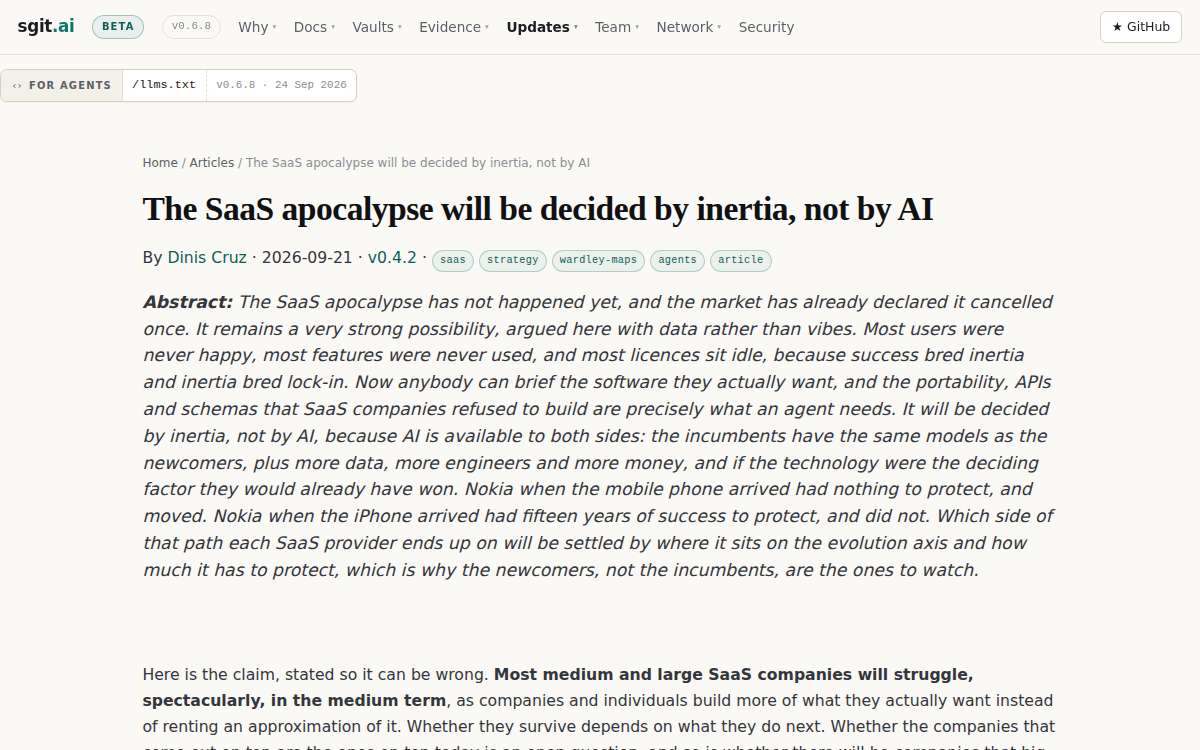
sgit.ai's second article of the day, from the author's voice memos, argues with sourced figures that what SaaS companies refused to build is what agents need (version log, v0.4.2↗). It was first titled 'What SaaS refused to build is exactly what the agents need', then 'The SaaS apocalypse is optional', then 'The SaaS apocalypse belongs to whoever has the least inertia', because Nokia did not opt into either of its outcomes (version log, v0.4.3 to v0.4.5↗). The final title, The SaaS apocalypse will be decided by inertia, not by AI↗, carries the claim that AI is available to both sides (version log, v0.4.6↗). The address moved with no redirect, the old one returning 404 on purpose, and a new cover's strapline became a pull-quote: "Same AI. Different inertia." (version log, v0.4.7 and v0.4.8↗, the article↗).
A guard that did not guard, and a note that said so
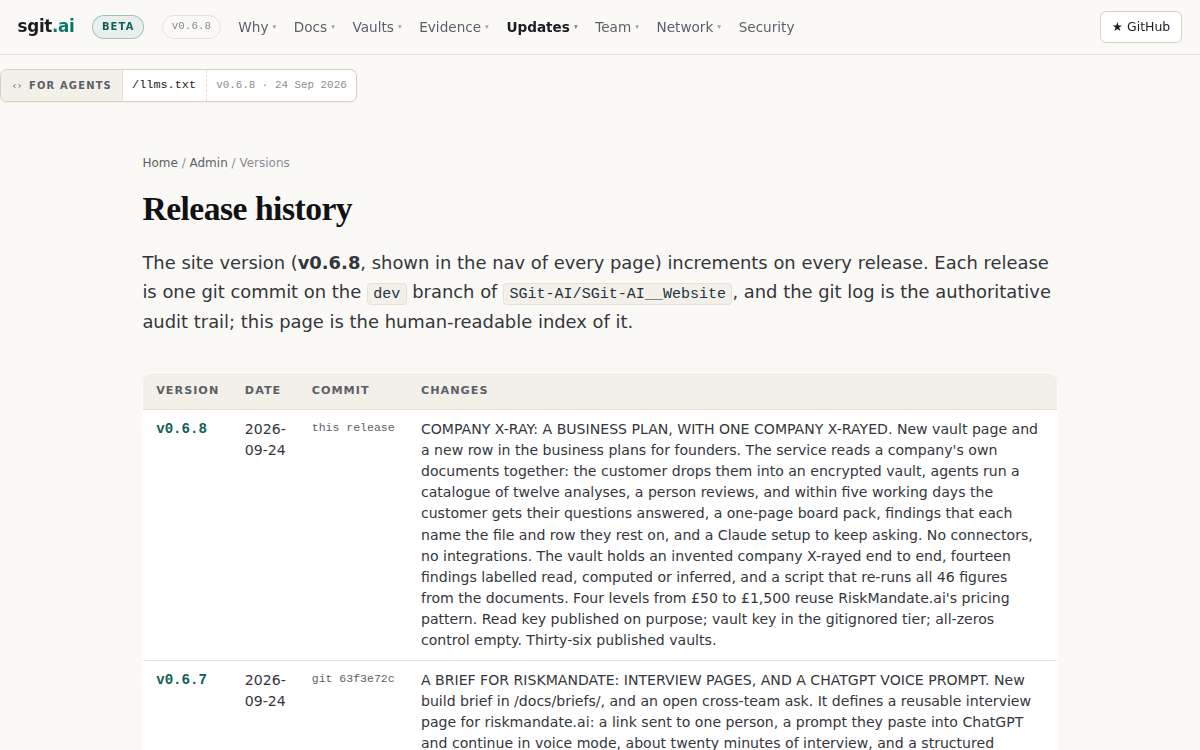
Shared links from sgit.ai showed no picture because pages carried no og:image at all, and the site's figures are WebP, which LinkedIn's crawler does not read (version log, v0.5.0↗). v0.5.0 added generated JPEG cards and a validator check (version log↗). Twenty-five minutes later (git log), v0.5.1 opened: "THE GUARD SHIPPED IN v0.5.0 DID NOT GUARD THE CASE THAT MATTERS, AND THE NOTE FOR IT OVERCLAIMED." (version log↗). A new article with a hero and no card would have shipped the default card silently; the build now refuses it, and the release script runs the generator (version log↗).
The disclaimers get a home: Lessons learned
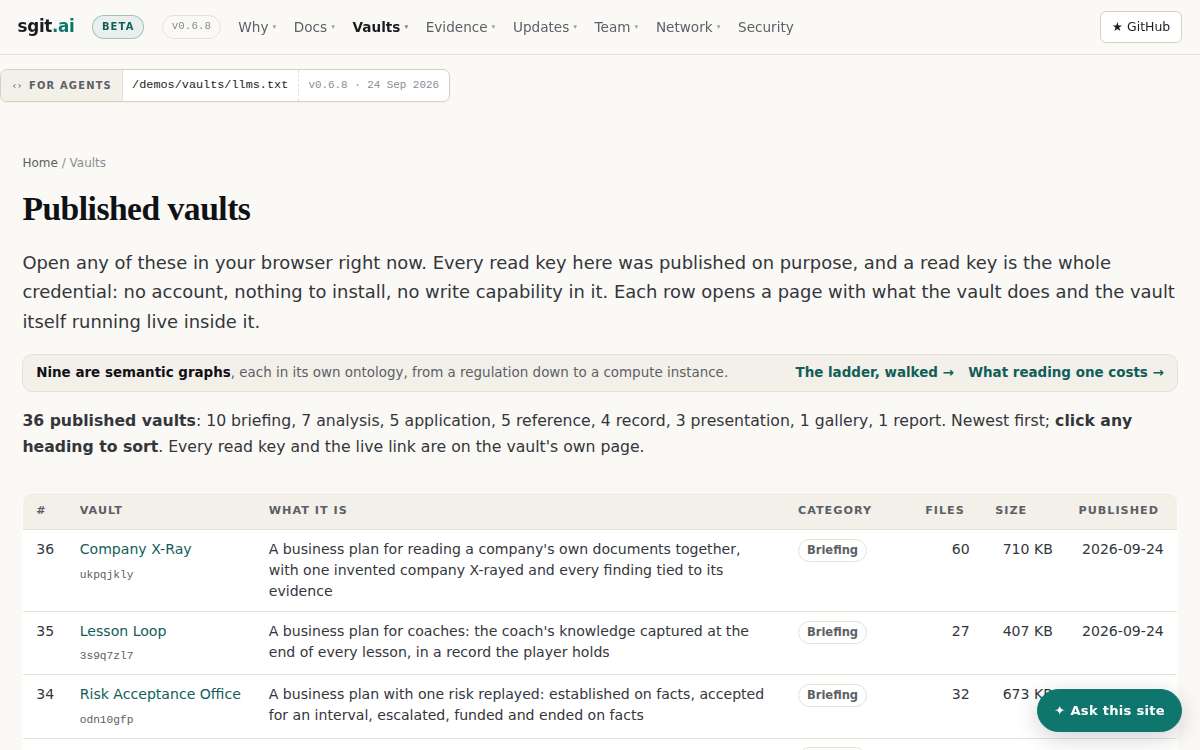
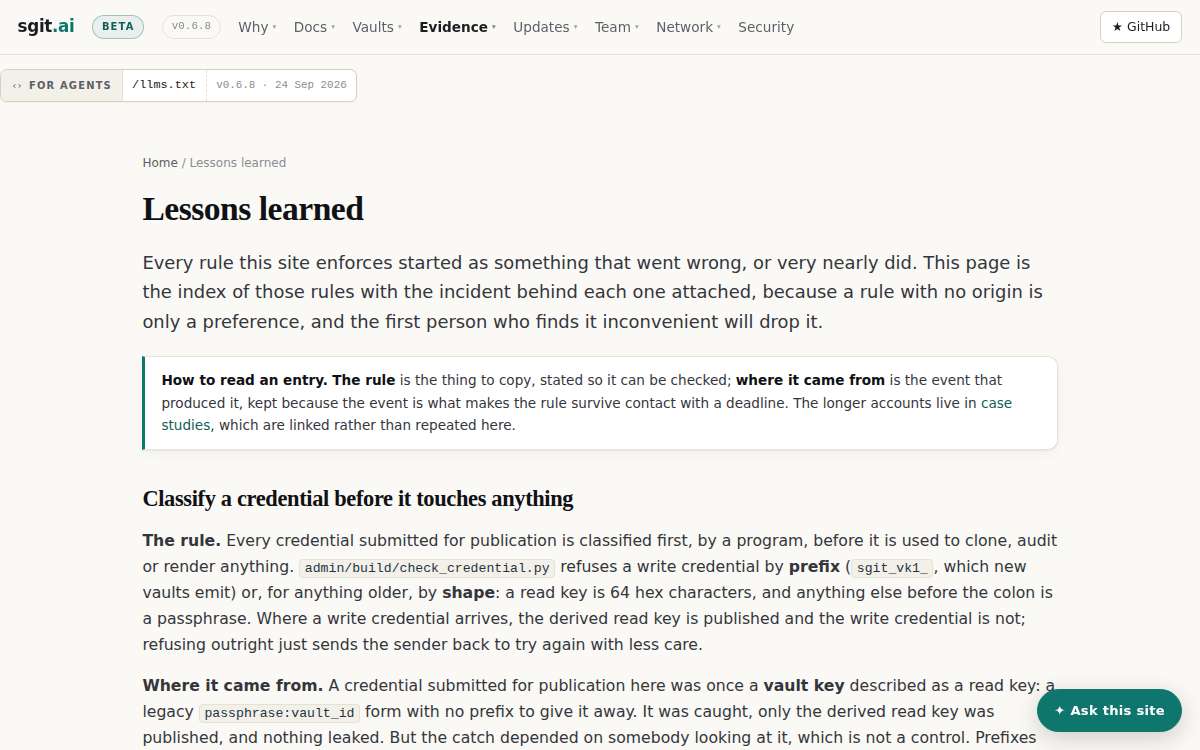
The published vaults page opened on four boxes of process and policy before a single vault, and v0.4.1 moved the table up from 919 px to 492 px at desktop width (version log, v0.4.1↗, the vaults page↗). Nothing was thrown away: the notes became entries on a new Lessons learned↗ page, which pairs each rule with the incident behind it (version log↗). Its premise is that "a rule with no origin is only a preference, and the first person who finds it inconvenient will drop it." (Lessons learned↗).
Everything else, by site
sgit.ai
- v0.3.7: the performance page is linked from the homepage, the docs index, comparisons, the vaults index and the fractal page's lead, with no content change (the page↗).
- v0.3.8: a Fractal Semantic Graphs band on the homepage↗, with the definition, the evidence and the measured cost (version log↗).
- v0.3.9: a missing closing bracket in every article's title tag, left by the em-dash rewrite, is fixed (version log↗).
- v0.4.1: the ladder count is corrected to nine vaults on three pages that had drifted when the DSIT vault became a step (version log↗).
- v0.4.3: every article's summary now renders as an italic Abstract, and the startup article gains its cover (version log↗).
- v0.4.9: the phone menu, 1536 px tall against a 664 px viewport, now scrolls itself, and two grids stop overflowing at 320 px (version log↗).
- v0.5.0: sixteen page titles with an unbalanced bracket, more em-dash rewrite collateral, are closed (version log↗).
- v0.3.4: the design is the performance↗, with decryption measured at about a tenth of the JSON parse.
- v0.3.5: that was a cold start, not an architecture cost↗, with batching measured at 0.25 s fixed plus about 71 ms per object (version log↗).
riskmandate.ai
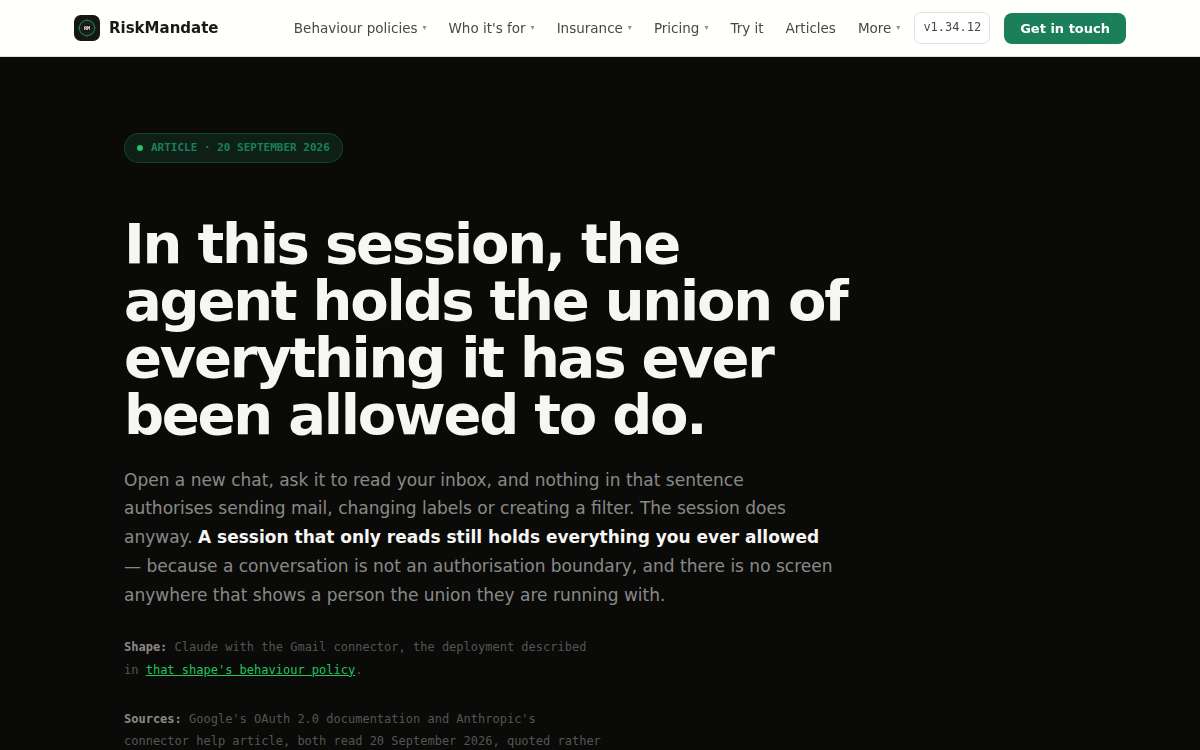
- v1.27.3: the third article is retitled In this session, the agent holds the union of everything it has ever been allowed to do↗, gains a staircase figure, and every article now ends with a "Where this connects" grid linking abp.sgit.ai, nhi.sgit.ai and store.sgit.ai (v1.27.3↗).
- v1.28.0: an admin console build bug, a link resolver used before it was initialised, is fixed (v1.28.0↗).