A quiet day by count and a busy morning on sgit.ai: one long article on the future of news, rewritten twice before ten, then given a byline and a page for that byline to point at. On riskmandate.ai the reviewed level got a written workflow and a list of who runs it, and that list leans on the same author page.
Lead: The future of news is the story vault, argued in three passes and then signed
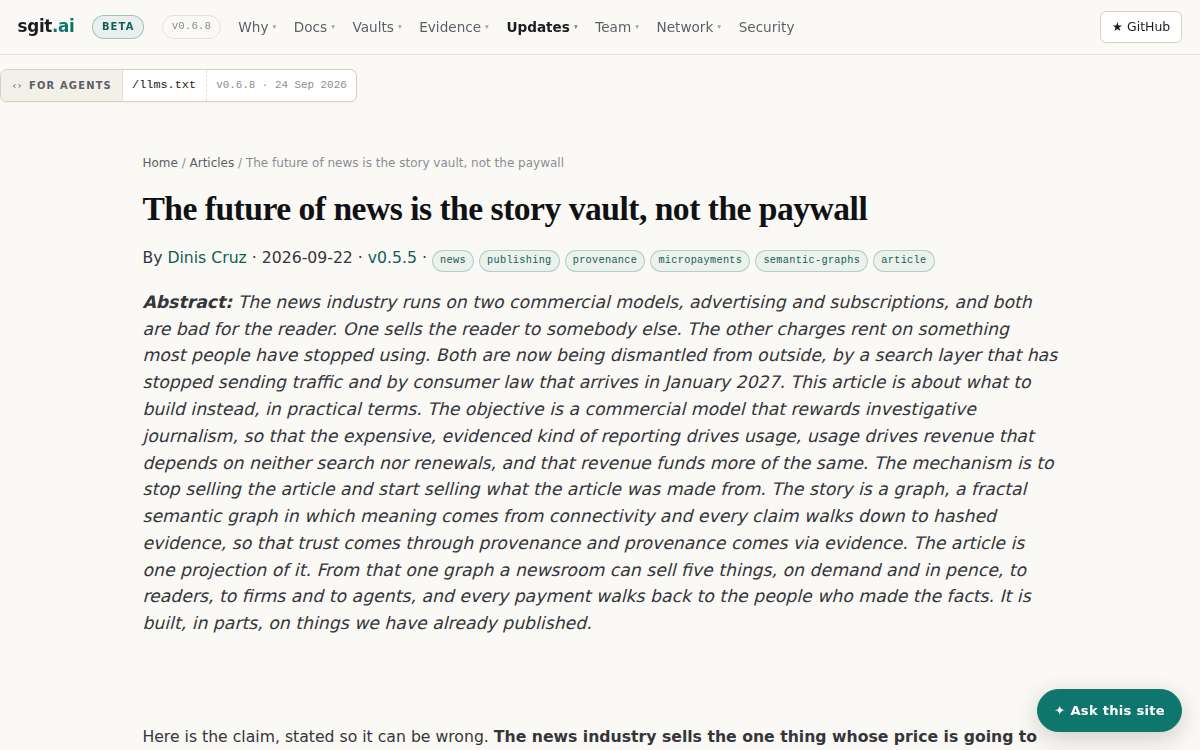
sgit.ai published The future of news is the story vault, not the paywall↗, a first-person article whose claim is in its own bold line: "The story is a graph. The article is a projection. Sell the graph." The version log↗ says it was written from a voice memo, the earlier future-of-news pieces and the newsroom sites of the network.
The article names five things a newsroom could sell from one graph: the free public article, a licensed article, an evidence vault, a customised projection and a verification API (the article↗). It proposes a split of 60 to the original researcher, 25 to the data organisation, 10 to the journalist and 5 to the outlet, and calls those numbers "a proposal" (the article↗). It is plain about what is not built: "Nothing on sgit.ai is wired to any of those rails today" (the article↗).
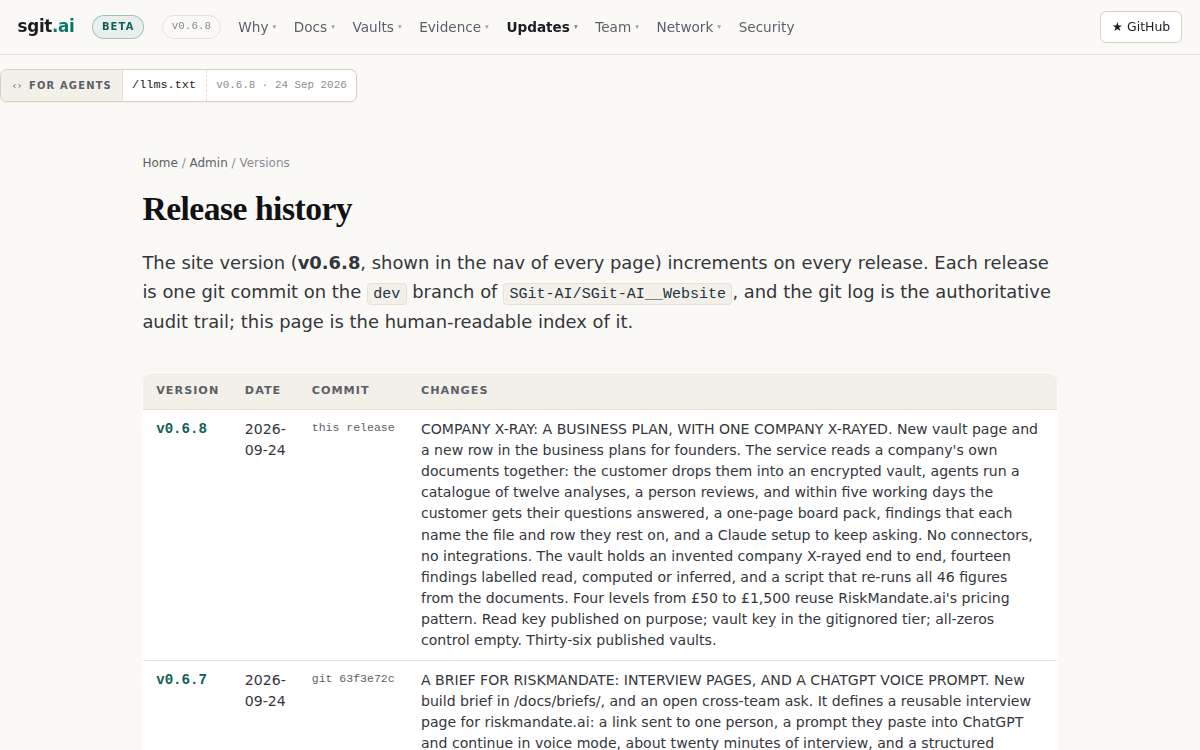
The piece changed three times in one morning. The site's git log records v0.5.2 at 08:10, a second pass at 08:34 and a third at 09:04. The second pass added an executive summary and the mechanics of each thing to sell, because the first "described the problem well and the solution thinly" (version log↗). The third added the fractal semantic graph and the ladder of trust, provenance and evidence, after "The author read it halfway and noticed the piece said graph without saying which kind." (version log↗).
The morning ended on provenance for the author as well as the argument. At 09:33 the site gave its first-person articles a byline, and at 09:44 it published a profile page for that byline to link to (git log). The same day riskmandate.ai built its first reviewer page from, among other sources, the author pages on sgit.ai (riskmandate.ai v1.29.0↗). Both stories are below.
Also today
A byline, because the argument is provenance
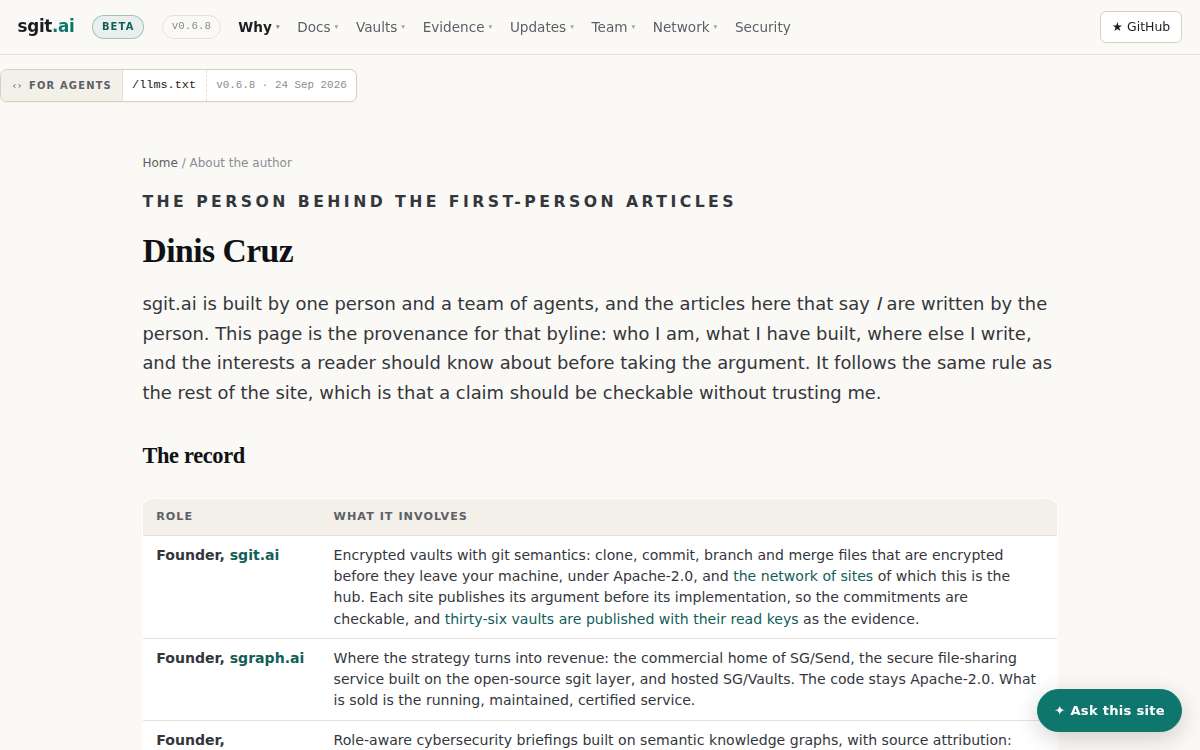
sgit.ai's articles can now carry an author and an author URL, shown as a byline and published as a schema.org Person (version log, v0.5.5↗). The trigger, in the log's words, was that the news article is first-person on "a site whose argument is provenance" and named nobody (version log↗). The build now refuses an author without a URL, "because a byline without a link is a name, not provenance" (version log↗). Four first-person articles were signed and the site-voice ones stay unsigned (version log↗). Eleven minutes later v0.5.6 pointed those bylines at a new About the author↗ page instead of LinkedIn (version log↗, git log). The page lists the founder's companies, the signed articles, writing on other network sites and interests declared, and says "a claim should be checkable without trusting me" (About↗).
riskmandate.ai writes down its reviewed level, and who runs it
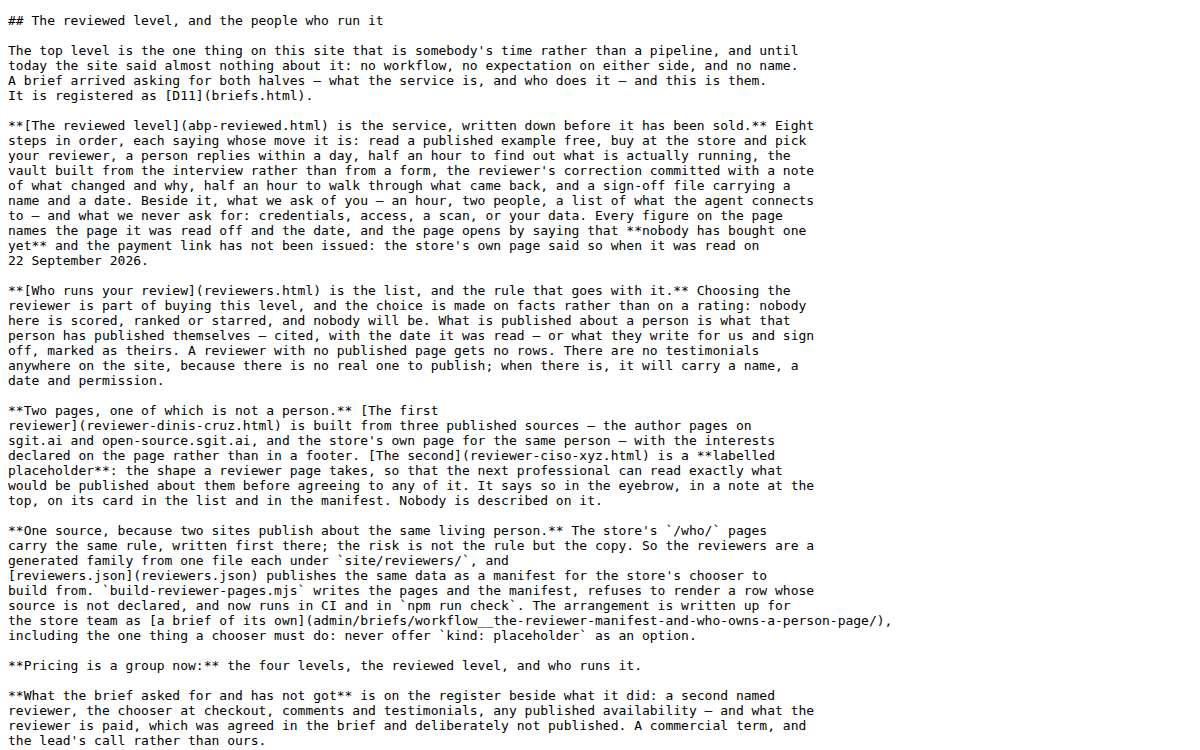
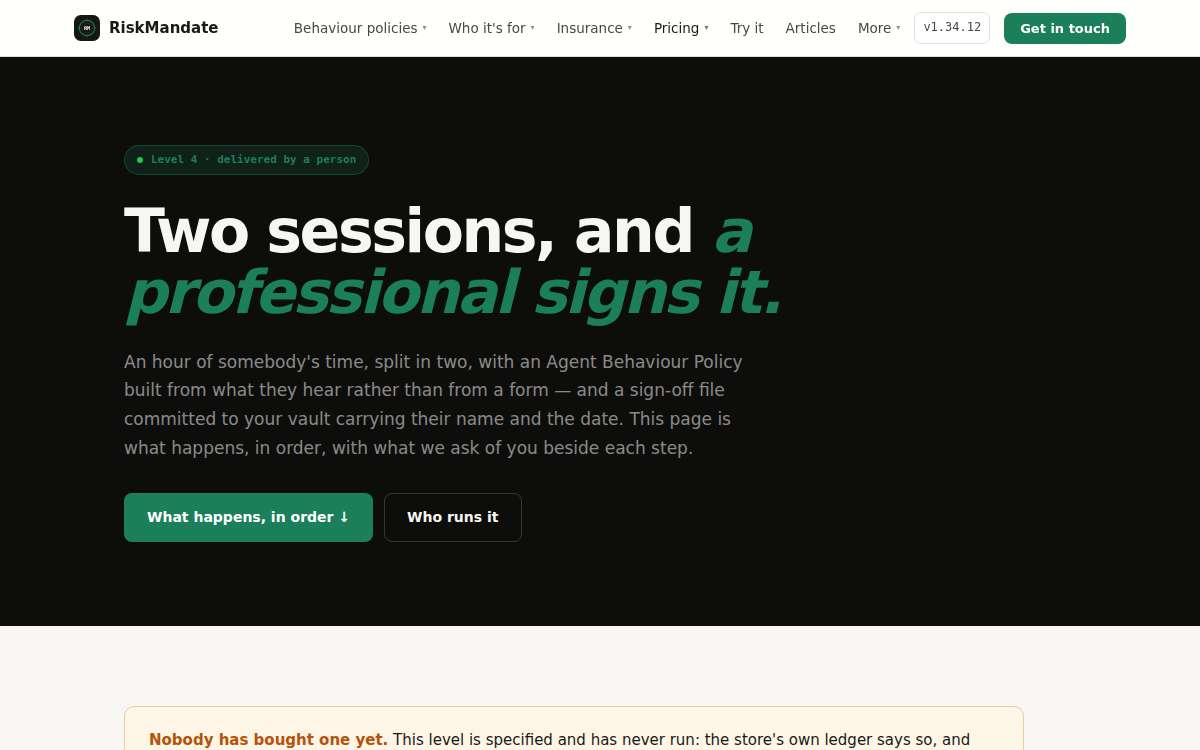
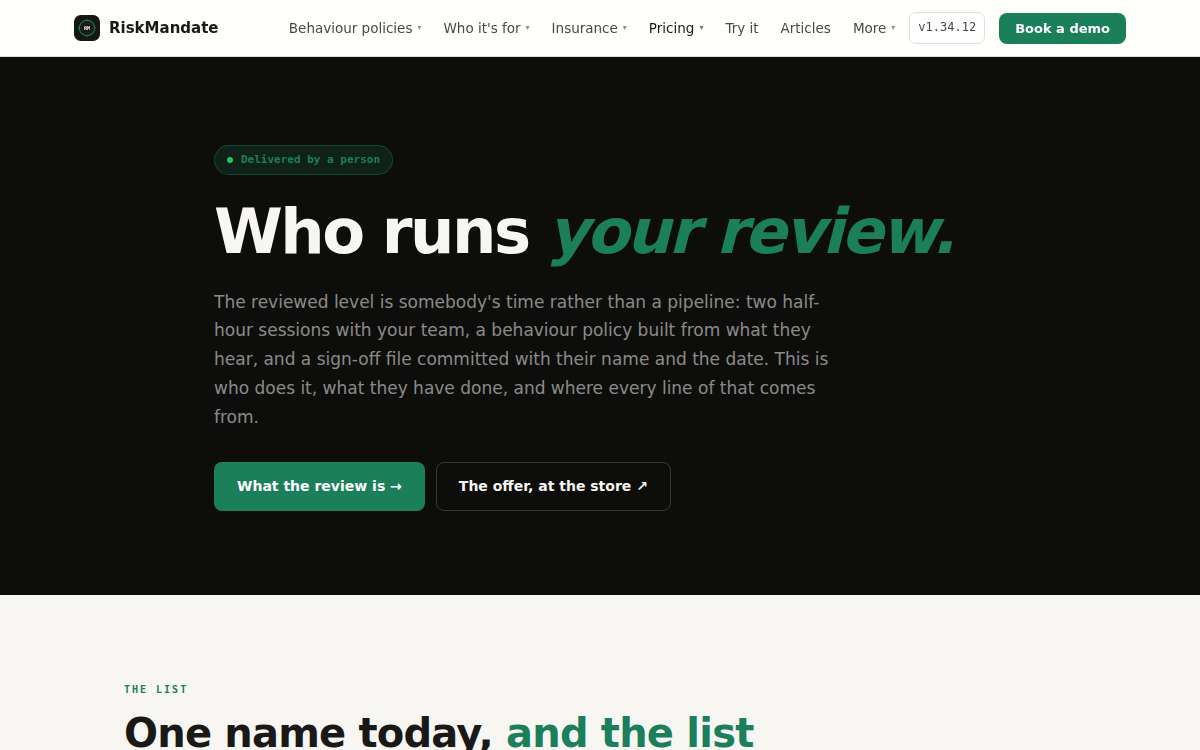
riskmandate.ai v1.29.0 answers a brief, registered as D11, that asked what the top level of its service is and who does it (release note↗). The reviewed level↗ is set out as eight steps, each saying whose move it is, and the note calls it the service "written down before it has been sold" (release note↗). Who runs your review↗ lists one named reviewer and one page that is a labelled placeholder, and says nobody on it is scored, ranked or starred (reviewers↗). Reviewer pages are generated from one file each, with a JSON manifest for the store's chooser (release note↗). What the reviewer is paid was agreed in the brief and deliberately not published (release note↗).
Everything else, by site
Every change of the day is covered in the stories above. For the record, all of them:
sgit.ai
- v0.5.2: new article, the future of news is the story vault, not the paywall↗ (lead).
- v0.5.3: the news article, second pass↗ (lead).
- v0.5.4: the news article, third pass, adding the fractal semantic graph↗ (lead).
- v0.5.5: articles get a byline↗ (above).
- v0.5.6 and a new page: About the author↗ (above).