6 · Fractal is a testable claim
After this chapter you will be able to tell a fractal system from a merely hierarchical one with a test that either passes or fails, and you will have seen the test applied to this estate's own work, including where it fails.
"Graphs of graphs of graphs" sounds like a flourish. It is meant literally, and it commits you to four specific things.
| Claim | What it commits you to |
|---|---|
| Self-similarity | The same grammar at every altitude: every edge a verb with a named inverse, meaning in connectivity and never in properties, supersede never delete, provenance kept. Never the same schema. A property, a paragraph, a person and a national estate share the grammar and nothing else. |
| Scale invariance | One validator, one query engine, one provenance rule. They check the grammar, which is why they run unchanged over any ontology. |
| Composition | Graphs combine into graphs by declared edges between them, never by merging their vocabularies. Risk registers of risk registers, each in its owner's words. |
| Recursion | Zoom into any node and it expands into a graph with its own ontology: its own node types, its own verbs, its own taxonomy, chosen by whoever owns that altitude, still obeying the shared grammar and still joined by an edge to the node you opened. |
What "rules" means here, because the word does all the work. The 12 July brief that first set out the four commitments defines them in the same sentence: "the same node and edge grammar, the same validators, the same query engine, and the same provenance rule apply at every altitude." Those four are the rules. The vocabulary is not on the list, and sixteen days later the same author says so outright, of a regulation being turned into a graph:
some articles will be substantial enough to need their own ontology and taxonomy rather than fitting the one above, which is not a complication but the expected fractal behaviour
— Every Paragraph Is A Graph, 28 July 2026
Read "rules" as "schema" and the claim collapses into a description of a folder tree, which is the opposite of what it says. Read it as grammar, which is what the source says, and a new ontology at every altitude is not an exception to the claim; it is the claim.
This estate has corrected itself on exactly this point once before, and did not finish the job. On 23 August 2026 the founder recorded that the planning pack had defined fractal as uniformity, one grammar and one validator and one query engine everywhere, and that uniformity is the mechanism rather than the claim; the claim is composition with local override, where any scope may extend, specialise or override the shared vocabulary without asking the centre. The Universe volume carries that correction with both definitions kept and the old one marked superseded from its date. It never reached this chapter, which went on stating the uniform version for two book versions, nor the agent surface, which stated it for four weeks after that. A correction recorded in one book and not propagated to the other two is the same failure as a document drifting from its source, one layer up, and the only reason it was caught is that a reader of a sibling site wrote in to say the claim was backwards.
<div class="claim">
The zoom test, in two halves. If zooming in lands you in the same types, the same verbs and the same vocabulary all the way down, you have a hierarchy, not a fractal; a folder tree is the clean example. If zooming in needs a different grammar, so that the inside is no longer a semantic graph at all, the claim is false. Between those two, every zoom that opens a new ontology joined by a named edge to the last is the claim working.
</div>
The second half is the falsifiable part and the first half is the one that gets forgotten, because a system that never changes vocabulary looks tidy and passes for fractal until somebody tries to attach a world it was not designed for.
Almost every system that calls itself hierarchical passes a weaker test: it has levels, and the levels nest. That is not the same thing. A folder tree has levels. A file inside a folder is not a folder, and you cannot apply folder operations to it. That is hierarchy. Fractality is the stronger claim that the operations at one level are the operations at every level.
What fractality buys you is that the system has no natural stopping point and no integration tax. From the corpus: "there might be an article that is so meaty that it requires its own ontology and taxonomy, and that's the power of the fractal element." The graph starts wherever the work is ("it is kind of like a Lego structure where one feeds to the other") and grows outward from there, which is also why it does not matter where you start.
Applying the test to this estate
The first edition of this argument stated the four commitments and could not test them, because nothing in it zoomed. The second edition zooms twice, deliberately, at two different scales, and the test can now be run. This section runs it and reports what it returns, including the failures, because a chapter about a falsifiable claim that never reports a falsification is not doing its job.
Zoom one: a document, down to the word
The first zoom came from a memo of 26 August 2026:
"I should be able to start from the document and keep expanding it, like you know, bit by bit by bit by bit. Let's say on a tree structure, and I should be able to expand it all the way to the paragraph. In fact, all the way to the word, so the way to think about this is kind of like an AST, the abstract syntax tree, but you know, for now, very driven by the by the content itself."
The build that answered it gives the pilot document a core graph, which is a named ladder of node kinds:
   doc  ──contains──▶  sec  ──contains──▶  blk  ──contains──▶  sen  ──contains──▶  wrd
   document            section             block               sentence            word
                                        (para, bullet,
                                         code, quote,
                                         table)
                                             │                                      │
                                             │                                      │
                                          ┌──▼──┐                              ┌────▼────┐
                                          │ mk  │  span: bold, italic,         │    w    │  form:
                                          └─────┘  code, link, covering        └─────────┘  one node per
                                                   the word instances                       distinct word,
                                                   it marks                                 with its count
                                                                                            and every instance
Figure 6.1 · The core graph ladder, seven node kinds, from v2/universe/data/core/.
For the pilot document, that ladder resolves to real numbers, computed by the build: 39 sections, 186 blocks, 342 sentences, 4,221 word instances, 143 markup spans, and 951 distinct word forms. Every level has an identifier and every identifier is structural and deterministic, which is chapter ten's subject.
Two things about that ladder are worth naming as design choices rather than accidents.
Markup is structure, not formatting. A bold run is a span node that covers the word
instances it marks. The memo asked for exactly this: "if you have a bold, right? Let's
say, then you need to link. You need to have a node that links that bold, those three
nodes, to a bold, so we can basically understand which one of those are because the bold
has extra meaning." Emphasis becomes queryable rather than lost.
A word form is a node, not an attribute. One node per distinct form, carrying its count and the identifiers of every instance. Which means the question "where does this word occur, and what else occurs near it?" is a traversal rather than a search. 951 forms, 505 of which occur exactly once.
Zoom two: the code itself
The second zoom is a level most systems never attempt, and it arrived as a message sent minutes after the previous release went live: "That worked great, let's keep zooming."
The estate's meaning engine is built from twelve operators. Each operator is a small JavaScript file. The ask was to apply the same treatment to the source code:
"can you apply the graphs of graphs approach here, the visualisation of grouping specific parts of the code and providing an explanation on a right pane on what it does, what the variables do and what are the inputs and outputs of those inner bits of code."
What shipped is an anatomy per operator: the code sliced into contiguous segments,
each a node with an identifier, a kind (docs, imports, data, contract, step, export), an
explanation written for somebody who already knows the language, its variables with their
roles, what it reads and writes, and feeds edges to the segments it drives.
And the anchoring discipline came with it. Each segment is anchored by the exact text of its first line, the build resolves those heads to line ranges that must tile the file completely, and a gate fails the release the moment the code and the anatomy drift. So the code's graph cannot quietly become a lie about the code, which is the failure mode of every architecture diagram you have ever seen.
The bind operator's page ↗ (image on the live page; not in the snapshot)
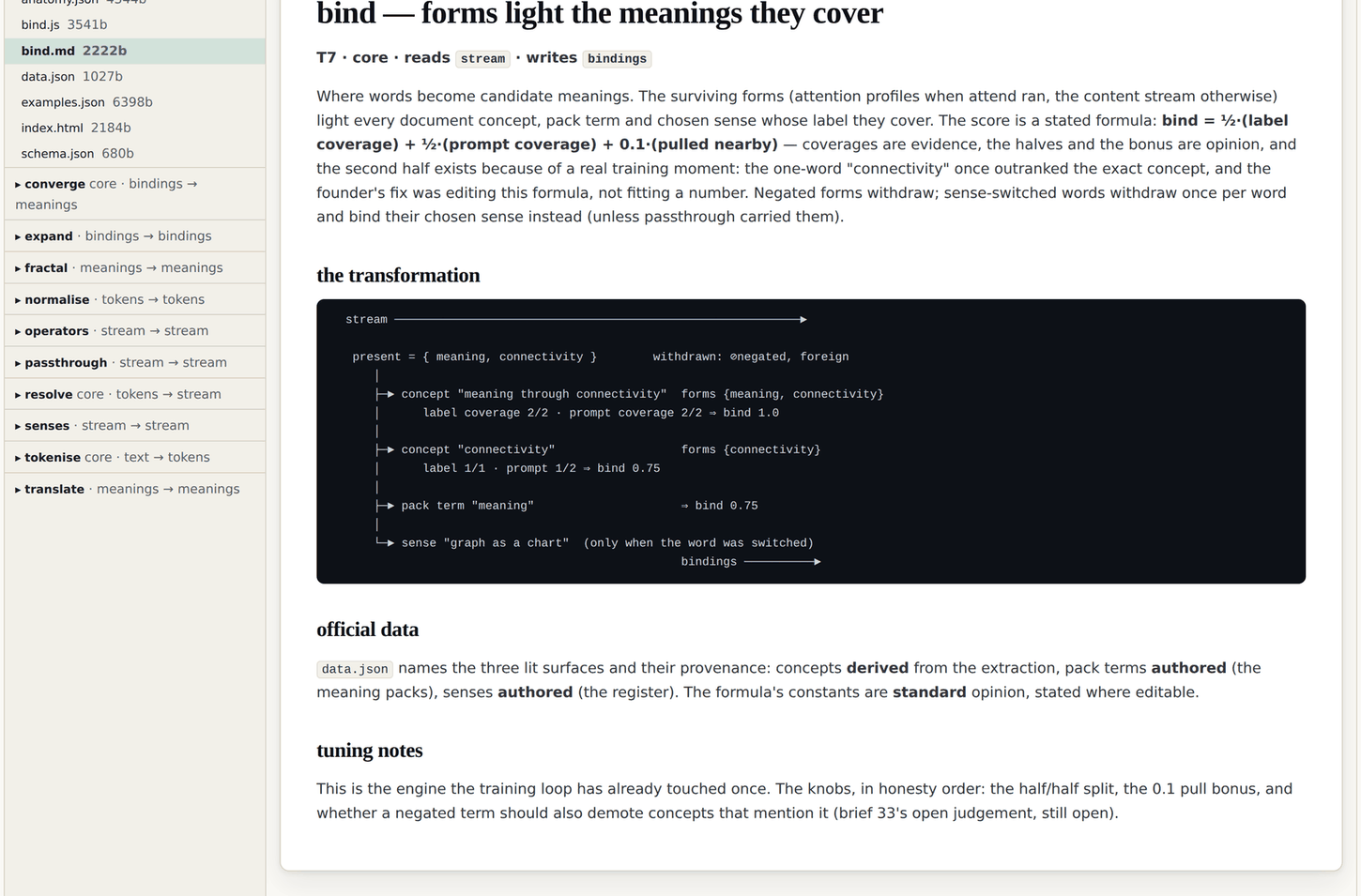
Figure 6.2 · One operator, zoomed: the bind engine's own page at
graphs.sgit.ai/v2/wclm/operators/, site version v0.5.11. Left: the twelve operator
folders, each with its code, schema, data, docs, examples and workbench. Right: bind's
contract (reads stream, writes bindings), its stated formula, an ascii diagram of the
transformation, and the provenance of its official data. The paragraph beginning "the
second half exists because of a real training moment" is chapter eleven's subject.
The verdict, honestly
Here is the test applied to the estate's own two zooms, one commitment at a time.
| Commitment | Verdict | The evidence, and the qualification |
|---|---|---|
| Self-similarity | passes at the reading layer | The document ladder, the extraction's concepts and claims, and the derived layers all render as nodes and typed edges in one canvas with one viewer. The schema view over the pilot shows nine node types and twenty-four typed relations, all in the same grammar. |
| Scale invariance | partial, and the weakest row | One viewer and one query surface across all levels. But not one validator: the extraction has its anchor gate, the core graph has its round-trip gate, the code anatomy has its drift gate. Three gates enforcing one discipline is not the same as one validator. The three serialisations belong here too, since a reader per shape is exactly what scale invariance is supposed to buy you out of. |
| Composition | passes | The engine's world is assembled from the extraction, the core graph's token analysis, the meaning packs, the senses register and the analogies register, with no adapter layer. Each is a graph; the composition is a graph. |
| Recursion | fails for the document zoom, passes hard at the engine layer | See below. The verdict here is not the one the first edition of this chapter reached, and the reason is worth more than the row. |
The recursion row is the interesting one, so it gets stated in full rather than summarised.
The verdict changed when the test was sharpened, and it got worse. Until book v0.3.0 this chapter tested recursion by asking whether the zoom needed a different file format, and answered that it did: the extraction is node and edge lists, the core graph is an index plus nested shards, the code anatomy is segments with feeds edges. Three serialisations, scored as a failure, with a decent engineering reason attached.
Under the test as it now stands, that was the wrong question and it produced a flattering answer. A different serialisation of the same grammar is not a different grammar; three readers is a cost against scale invariance, not a falsification of recursion. Fixing the test moved that complaint one row up, where it belongs, and left recursion to be judged on the thing that actually matters. Which is worse.
Where it fails: the document zoom is a hierarchy. Document, section, block, sentence,
word. Five altitudes, one vocabulary. Every level is a contains edge to a smaller thing
of a kind the level above already knew about, and the viewer that opens a section is the
viewer that opens a sentence because nothing new has appeared. By the first half of the
zoom test, that is a folder tree with very good addressing. It is genuinely useful,
the round-trip gate proving it lossless is genuinely hard, and it is not the fractal
property. The chapter scored it as a pass for two book versions because the old test never
asked the question.
Where the fractal move actually is, in the same estate. Not down the decomposition but
across it: the same pilot document carries two graphs at once, the core graph (sections,
blocks, sentences, words) and the extraction (concepts, claims, hypotheses, objections,
examples, with verbs like departs-from and licenses). Two ontologies, neither derived
from the other, sharing nodes by anchor. Open a word in one and you are in a lexical
world; open a claim in the other and you are in an argumentative one. That is a new
vocabulary reached by a named edge, and it is the thing the estate should have been
pointing at all along.
Where it passes, and passes hard. The engine has an operator called fractal whose
entire job is to be a full instance of the engine, inside the engine. It takes the winning
meaning's own statement and runs it through a complete inner pipeline (tokenise, resolve,
bind, converge), one zoom down, and reports the meaning of the meaning. It reads the type
meanings and writes the type meanings, exactly like every other operator, so the
pipeline cannot tell it apart from a simple one. It is registered, typed and swappable
like the rest.
That is recursion with no new format and no special case, in the strong sense: the system composes with itself, and the composition is invisible to everything around it. The inner pipeline contains no fractal operator, so recursion terminates at depth one by construction, which is a stated limit rather than an accident.
<div class="warn">
Why report a failing row at all, and why report a changed one. Because the value of a falsifiable claim is destroyed by never falsifying it, and because a test that only ever gets easier is not being used. Sharpening the zoom test cost this chapter a pass it had held for two book versions, and the honest reading of that is not that the estate got worse: it is that the old test was scoring the wrong thing and the estate was collecting credit for it. The document zoom is still the best-gated artefact here. It is simply a decomposition rather than a fractal one, and saying so is cheaper than the alternative, which is a reader discovering it.
</div>
Name clashes are not a problem
One practical consequence of fractality that saves an enormous amount of argument.
If each graph keeps its own vocabulary, then two graphs may both use the word "node" for
different things, and nothing breaks. The estate has a live instance of this and it is
slightly comic: the meaning engine has an operator literally named operators (it handles
the little words that flip meaning, such as without and not), while the same release
calls all twelve building blocks operators. The agent flagged it rather than renaming
either:
"The operators word now means two things … The folders adopt the brief's meaning; the T5 engine keeps its name inside the registry."
Under a global schema that is a collision requiring resolution. Under local vocabularies with a declared scope it is two words in two namespaces, and the fix is a note. The general rule: a name clash between two graphs is only a problem if you were planning to merge them, and chapter four is why you are not.
Where it does not matter that you start
Two smaller notes that follow from the same property.
It does not matter where you start. The graph will be deep where the work is and absent everywhere else. That is not a defect to apologise for. It is the property that makes the project finite. A graph that had to be complete before it was useful would never be either.
A bug is a divergence, not a breakage. "A bug is something that we have mapped in the graph that is not happening in reality." Which reframes it from "something is broken" to "reality diverges from the model", and leaves open which of the two is wrong. That reframing is only available in a system where the model is a first-class artefact rather than a document about the system.
<div class="note">
Where the live estate demonstrates this. The document ladder is browsable at
graphs.sgit.ai/v2/universe/thinking-in-graphs.files.html, where the authored folder and
the derived core data sit in one file tree and every file reads raw or rendered. The code
anatomy is at graphs.sgit.ai/v2/wclm/operators/, one folder per operator. The fractal
operator is at graphs.sgit.ai/v2/wclm/operators/fractal/, and it can be toggled into the
pipeline on the engine page with one click.
</div>