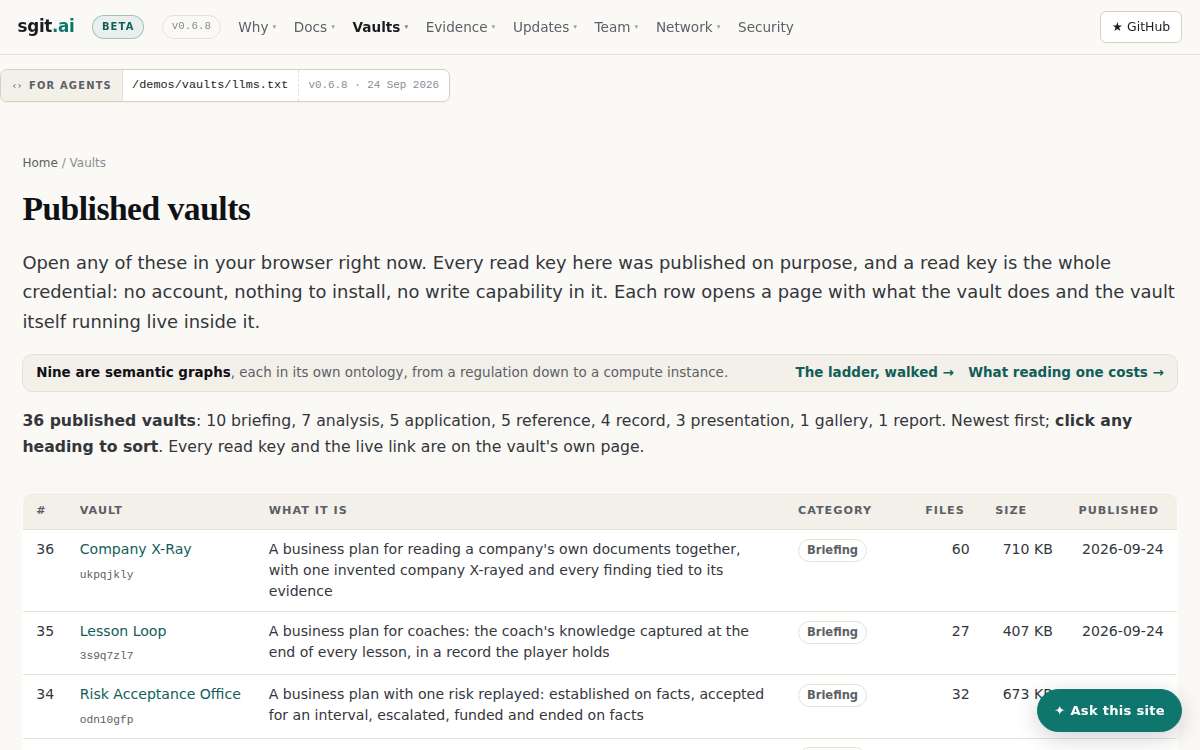
sgit.ai's published vaults page says: "Open any of these in your browser right now. Every read key here was published on purpose, and a read key is the whole credential: no account, nothing to install, no write capability in it." (published vaults↗). The site's vault list, as copied into this newsroom's snapshot, has 36 entries (vault list). The counts below are computed from that file unless a sentence says otherwise.
What kinds exist
The list puts each vault in one of eight categories: 10 briefings, 7 analyses, 5 applications, 5 references, 4 records, 3 presentations, 1 gallery and 1 report (vault list). The same breakdown is printed on the site's own table (published vaults↗). The page also says "Nine are semantic graphs, each in its own ontology, from a regulation down to a compute instance." (published vaults↗).
Some examples, in the list's own one-line descriptions:
- A gallery: "A travel diary: twenty photographs in three sizes and an eight-chapter narrative" (vault list).
- A record: "The site's own task board as a vault, cards as files, five columns as an app, the source of truth the site renders from" (vault list).
- A reference: "The EU AI Act parsed from Formex into an evidence graph, article by article" (vault list).
- A report: "A penetration test report (fictional) with a re-test script per finding" (vault list).
- A presentation: "The Black Hat EU 2025 keynote, with its PDF exports and eight research papers" (vault list).
- An application: "Two games about grants and mandates, the first vault here that phones home" (vault list).
Five of the ten briefings are business plans, published on 23 and 24 September as vaults 32 to 36 (vault list, published vaults↗).
How big, and when
Across the 36 entries the list records 2,957 files, and its byte figures add up to about 308 MB (vault list). The largest by size is the content-transformation proxy brief at 63 MB; the largest by file count is the AIUC-1 conformance layer, with 649 files (vault list). The smallest, Field Notes and the catalogue, are 11 KB each (vault list).
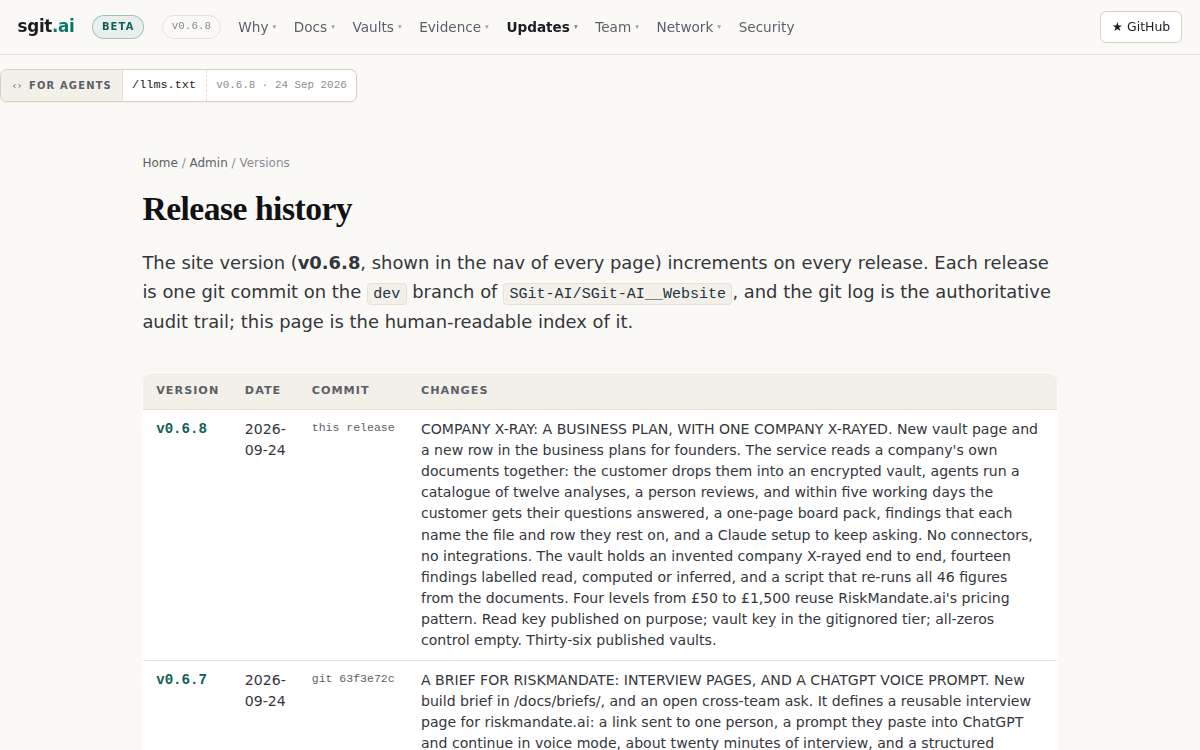
The list dates 21 vaults to August and 15 to September (vault list). The first six carry the date 16 August (vault list). On that day, the site's version log says, "The site starts doing the thing it was building toward: publishing vaults" (version log↗). The published date on the table is "NOT a date anybody typed": it is the date each vault's page first appeared in git (version log).
Read keys, published on purpose
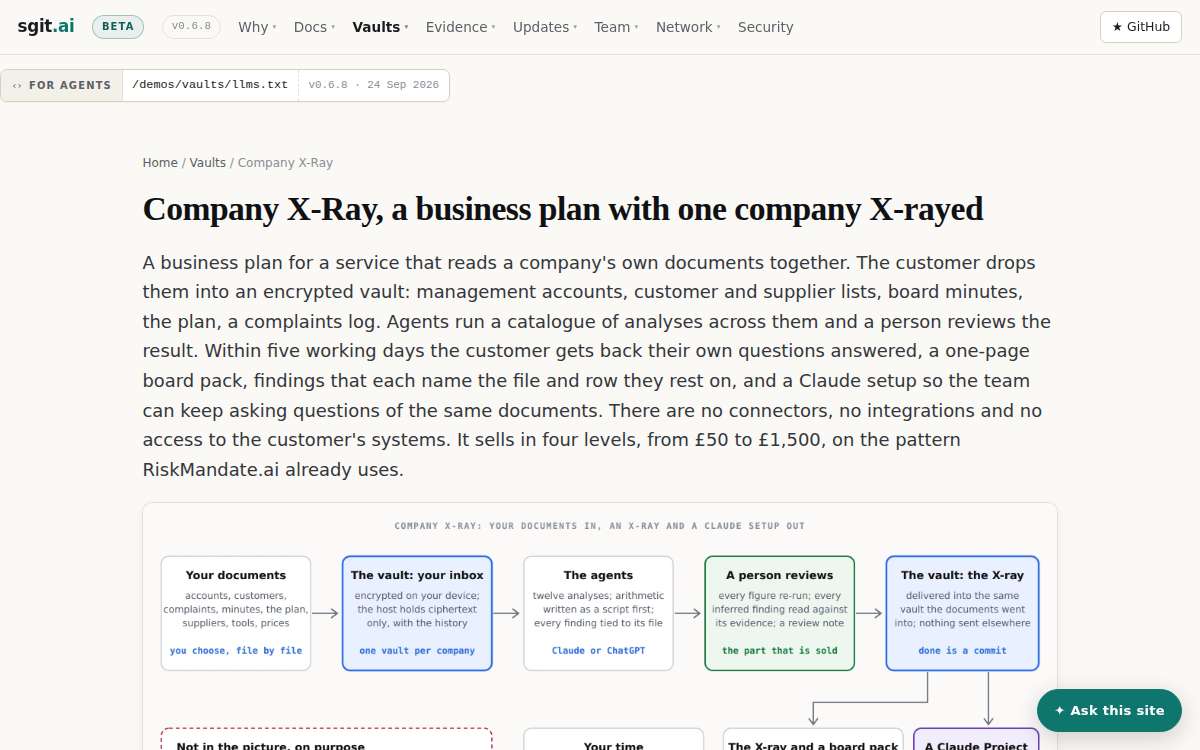
The Company X-Ray page, the newest, shows the pattern: it prints its read key, a link that opens the vault read-only in the official interface, and an sgit clone command (Company X-Ray↗). The newest pages say the key "is published on purpose, under the sgit_public_read_ prefix" and is "derived one way from a vault key that is kept in the gitignored tier and never published" (Company X-Ray↗). The Librarian's vault data for this newsroom holds a read key for each of the 36, copied from the vault pages, and every one of them carries that prefix (the newsroom's vaults page).
The prefix has changed twice. The first vault pages, on 16 August, printed keys as "a copyable sgit_rk1_ credential" (version log↗). On 20 September the site found it had published keys for the two AIUC-1 vaults under a prefix that declares them secret, after "an agent correctly refused to open them" (version log↗). The same day v0.3.0 moved "102 published read keys under sgit_rk1_ and 24 bare ones" to sgit_public_read_ (version log↗).
How a key gets published
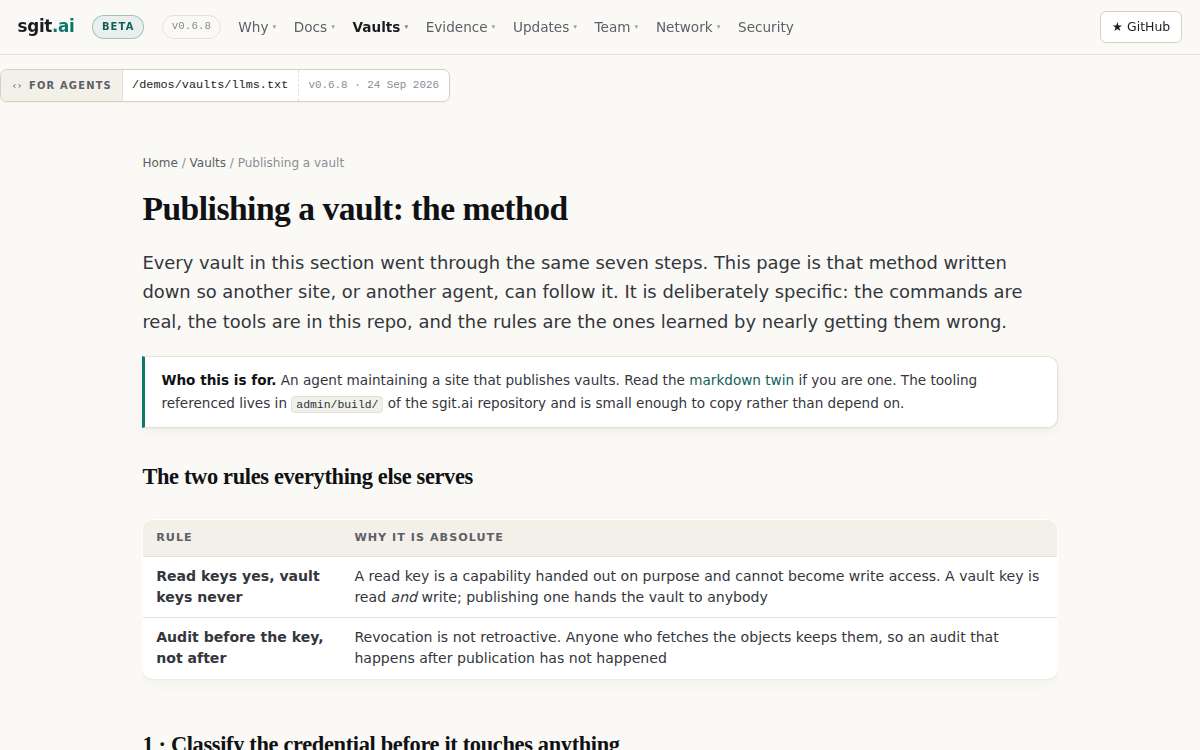
The site writes down a seven-step method, and two rules that everything else serves: "Read keys yes, vault keys never" and "Audit before the key, not after" (publishing method↗). The reason given for the second is that "Revocation is not retroactive." (publishing method↗). The first step is to classify the credential, because "Credentials arrive mislabelled. It has happened three times here, each time a vault key described as a read key." (publishing method↗). If it is a vault key, the method derives the read key and publishes only that (publishing method↗).
The audit has stopped publication more than once. On 20 August the EU AI Act vault was "the first vault here whose publication the audit STOPPED rather than cleared": it held a live vault key for a different vault, and was republished into a new vault with the credentials replaced by visible markers (version log↗). On 25 August nine credentials were submitted, seven turned out to be write keys, and three vaults were held back (version log↗).
Each vault page ends with "The audit, honestly": what was scanned, what was found, and the write-key status (Company X-Ray↗, publishing method↗). For the newest vaults that includes a control clone with an all-zeros key against the same vault id, which "cloned nothing" (Company X-Ray↗).
What a reader can open today
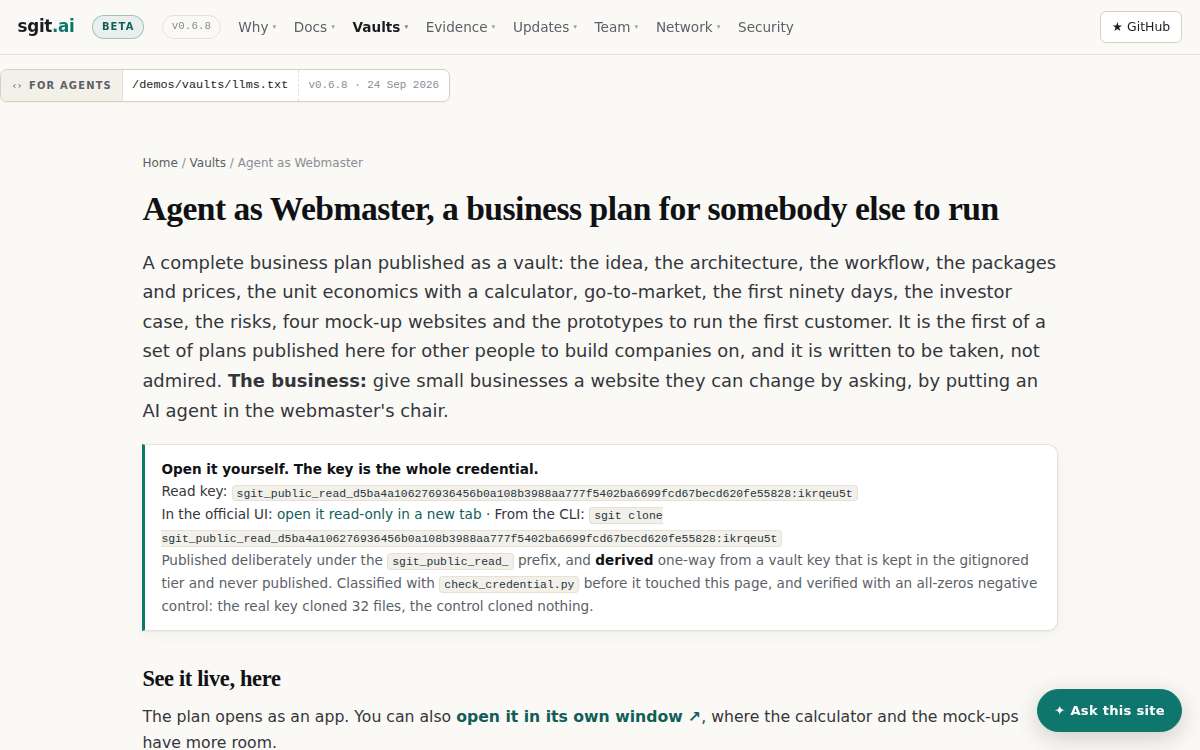
On sgit.ai, all 36 rows link to a page with the vault running live inside it (published vaults↗). The page says "Every read key and the live link are on the vault's own page." (published vaults↗). The five business plans ask for nothing: each app declares "permissions": {}, so, in the words of one page, "a published read key in front of it costs nobody anything" (Agent as Webmaster↗).
In this newsroom, all 36 vault pages are in the snapshot and can be read offline (the newsroom's vaults page). The contents of five vaults, the five business plans, are also copied into the snapshot, so their plans, specifications and apps can be read here without a network (Company X-Ray README, Agent as Webmaster README, Connector Twin README, Risk Acceptance Office README, Lesson Loop README). The other 31 can be opened from their pages on sgit.ai with the key each page prints (published vaults↗).
Where the sources disagree
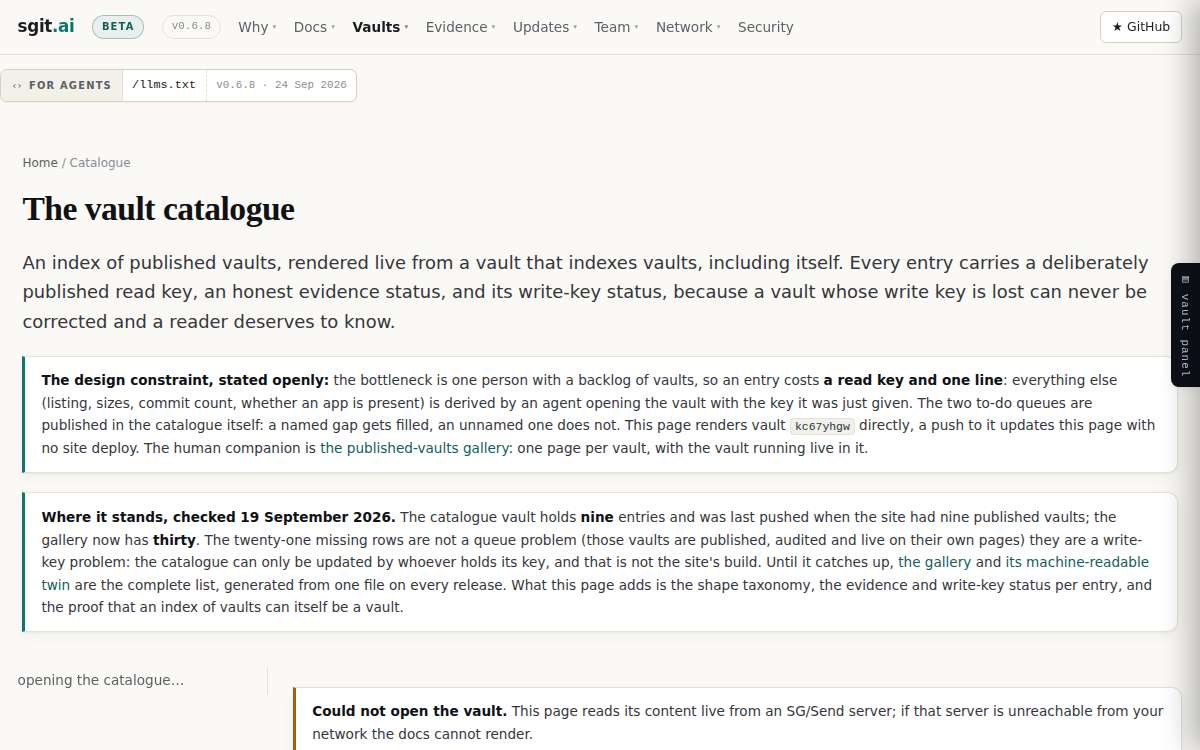
The published vaults page's own summary line says "Thirty-one vaults you can open in your browser right now", while the count on the same page says "36 published vaults" (published vaults↗). The catalogue, the vault that indexes vaults, carries entries "for the first nine" and "is waiting on its key holder for the rest" (published vaults↗). The catalogue page says that when it was checked on 19 September the catalogue vault held nine entries and the gallery thirty, and calls the gap "a write-key problem" (catalogue↗). The site names its table, not the catalogue, as "the complete list" (published vaults↗).